
1. Executive Summary
This report explores the business transformation of Desa Murni Batik, a 49-year-old traditional batik company that has evolved from a family-run textile shop into a nationally recognized fashion brand under third-generation leadership.
Under the stewardship of Ahmad Akram Anwar, the company shifted from heavy reliance on offline retail to becoming a digitally driven enterprise. A decisive pivot during the COVID-19 pandemic, coupled with mentorship under the Titanium Program by RCG (RichWorks Consulting Group), proved instrumental in this transition.
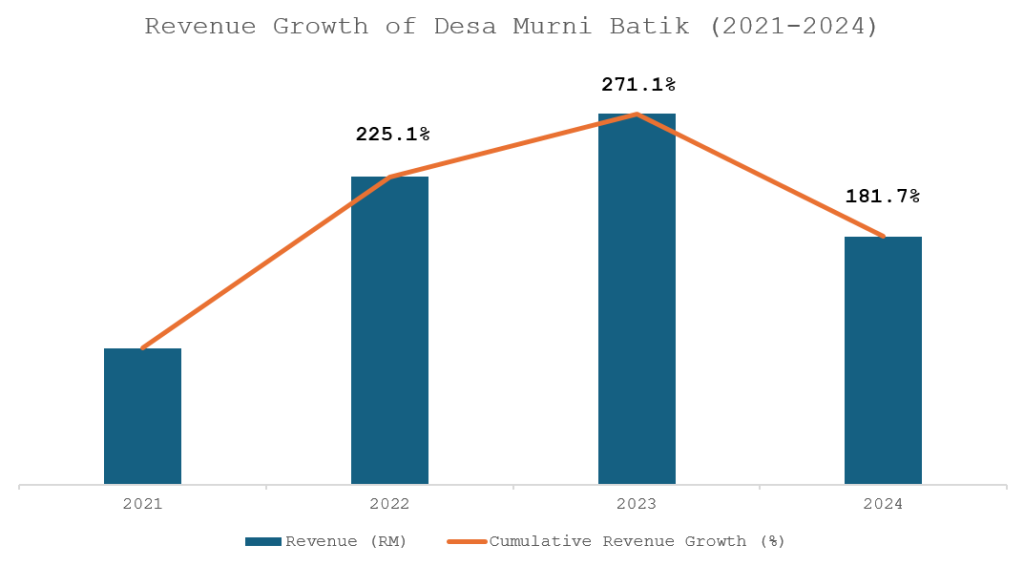
As a result, Desa Murni Batik recorded significant performance leaps — achieving 225% cumulative revenue growth in its second year of transformation, further accelerating to 271% in the following year. Despite market corrections thereafter, the business sustained a strong position at 181% cumulative growth relative to its baseline, underscoring its resilience, customer loyalty, and expanded digital reach.
This report outlines:
- The multigenerational journey from legacy business to modern retail
- Sales growth across four years and the digital expansion strategy
- Key operational challenges and leadership development outcomes
2. Business Overview
- Company Name: Desa Murni Batik
- Industry: Fashion & Textile – Traditional Batik
- Core Offerings: Ready-to-wear batik apparel, men’s baju melayu, corporate uniforms, digital print batik
- Business Model: Omnichannel retail – physical outlets + eCommerce + live selling
- Target Market: Malay families, working professionals, civil servants, heritage fashion consumers
3. Financial & Performance Analysis
Revenue Growth
Desa Murni Batik experienced transformative growth between 2021 and 2023, reflecting the impact of Ahmad Akram Anwar’s leadership and strategic guidance from RCG (RichWorks Consulting Group). In its first year of restructuring, the business established a revenue baseline through offline channels while laying the foundation for digital expansion.
By 2022, Desa Murni Batik achieved 225% cumulative revenue growth relative to its baseline, fuelled by a decisive eCommerce pivot, the adoption of live selling, and internal restructuring under RCG’s Titanium Program. This upward trajectory continued in 2023, when cumulative growth climbed further to 271%, supported by expanded SKUs, national visibility, and seasonal festive campaigns that strengthened customer reach.
In 2024, revenue corrected to 181% of the baseline, reflecting consolidation after a phase of accelerated growth. While the year marked a recalibration, the business retained a stronger and more resilient foundation than before, underscoring its ability to adapt to market realities while sustaining long-term momentum.
Operational Metrics
- Retail Presence: Flagship showroom in Kelantan; multiple pop-up locations during festive seasons
- Digital Contribution: 70%+ of 2023 revenue from online channels
- Product Designs: Over 200,000 designs produced to date
- Team Strength: 30+ full-time staff across design, marketing, operations, and fulfillment
Brand Engagement Metrics
- Facebook Followers: 5.2k
- Instagram Followers: 86.4k
- TikTok Followers: 48k
4. Industry Trends & Competitive Landscape
Key Market Trends
- Cultural Fashion Revival: Growing interest in modernized traditional wear
- eCommerce Domination: Rise of live-selling and digital-first purchasing behavior
- Youth-Driven Heritage Brands: Young founders giving fresh identity to legacy labels
Competitive Landscape
Competitors: Traditional batik shops, modern modest wear brands, online fashion boutiques, fabric wholesalers, and heritage-focused social enterprises.
Desa Murni Batik’s Advantage: A digitally-driven retail model with fast product rotation, youth-led storytelling, modernised traditional designs, and systemised operations from RCG mentorship.
The heritage fashion industry is experiencing a revival, driven by growing interest in modernised traditional wear—especially among younger consumers. The rise of eCommerce and live-selling has reshaped how these products are marketed and purchased, enabling wider reach and deeper engagement.
At the forefront are youth-led heritage brands, where new-generation founders are refreshing legacy labels through innovative storytelling, design, and digital strategies. In this evolving landscape, Desa Murni Batik competes with traditional batik shops, modern modest wear brands, online boutiques, fabric wholesalers, and heritage-focused social enterprises.
What sets Desa Murni Batik apart is its digitally-driven retail model with rapid product rotation, compelling brand voice, and seamless integration of traditional aesthetics with modern fashion. Supported by systemised operations developed through RCG mentorship, the brand has successfully bridged cultural heritage with digital scalability, positioning itself as a resilient and future-ready player in the batik market.
5. Key Challenges & Solutions
Desa Murni Batik’s growth journey was marked by both internal and external challenges—ranging from founder inexperience and team resignations to pandemic disruptions. These were addressed through a structured approach enabled by RCG mentorship.
| Challenge | Strategic Response |
| Lack of interest in business leadership (initially) | Akram gradually developed founder mindset through exposure, mentorship, and self-motivation |
| Resistance to digital channels pre-MCO | Pivoted overnight to eCommerce during MCO; adopted live-selling, digital campaigns |
| Weak leadership in early years | 15 staff resigned in second year; Akram sought executive coaching via RCG and rebuilt internal culture |
| Legacy constraints and generational tension | Earned father’s trust through proven results and operational improvements |
Challenge 1: Lack of Interest in Business Leadership
Akram initially had no intention of leading the business and was only helping out. With guidance from RCG, he gradually shifted his mindset, building leadership confidence through structured mentoring and exposure to entrepreneurship.
Challenge 2: Resistance to Digitalisation
The business relied on offline retail and was hesitant to go digital. When the MCO hit, Akram pivoted quickly—launching eCommerce, live selling, and social media campaigns. This move doubled sales and opened new markets.
Challenge 3: Weak Internal Leadership
Inexperience led to unclear roles and poor team dynamics, resulting in 15 staff resignations. RCG’s Titanium program helped Akram restructure the team, implement SOPs, and build a strong company culture.
Challenge 4: Legacy Constraints and Family Resistance
Akram’s digital ideas were met with resistance from his father. Instead of confrontation, he focused on delivering results. As sales grew and operations improved, he gained his father’s trust to lead more freely.
6. Conclusion & Future Growth Roadmap
Under Ahmad Akram’s leadership and RCG’s structured guidance, Desa Murni Batik has evolved from a traditional textile brand into a high-growth, digitally mature fashion business. From RM11 million to RM31 million in three years, the brand now commands national recognition and cultural relevance.
The company will focus on broadening its product range, enhancing digital and regional market penetration, strengthening backend infrastructure for scalability, and exploring international expansion opportunities to sustain long-term growth.
RCG’s Role in Client Growth
RCG played a pivotal role in Desa Murni Batik’s transformation—from building leadership capacity to implementing scalable business systems. Through Titan mentorship, Akram gained exposure to long-term business thinking, strategic planning, and peer insights that helped stabilize and grow the brand after initial stagnation.
RCG’s frameworks enabled Desa Murni Batik to shift from founder-dependent operations to a sustainable team-led structure, while maintaining creative freedom and brand heritage.
Want to scale your business like Desa Murni Batik?
Contact RCG (RichWorks Consulting Group) for strategic business coaching, team transformation programs, and scalable growth solutions.